The many applications of tarpaulins — and why quality protection matters
Transport, mining, construction, industry and storage — where tarpaulins earn their keep, and why the cheap ones cost more.
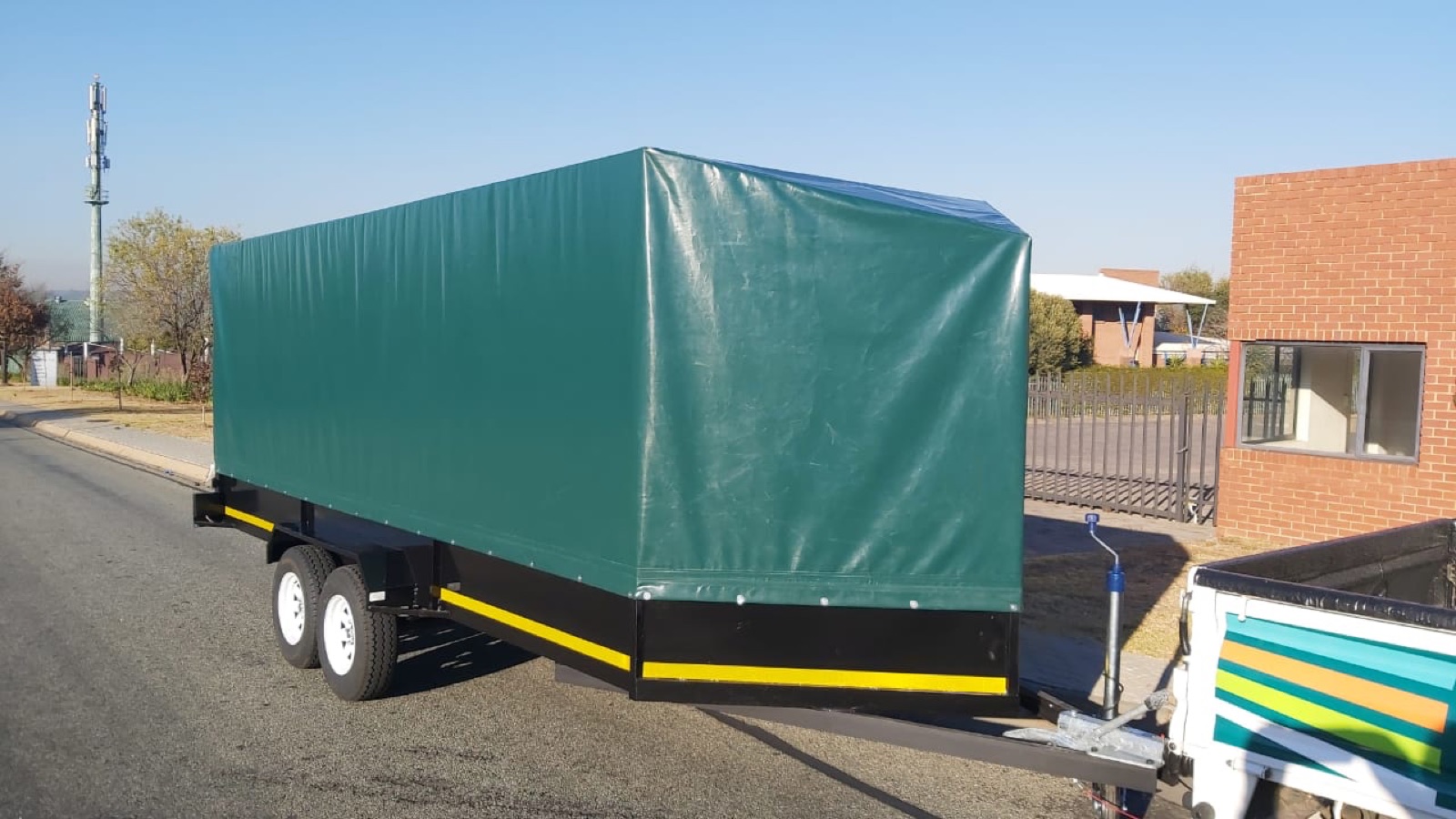
Tarpaulins quietly protect billions of rands of assets every single day — cargo on trucks, materials on construction sites, equipment in yards and stock in warehouses. They are unglamorous by nature, but when they fail, the consequences are very real: soaked stock, rusted machinery, write-offs and, in transport, the very real risk of loads shifting on the road.
That is why quality matters far more than price. A cover that splits at the seam, fades to brittleness after one harsh Gauteng summer, or lets moisture through at the welded edges is not a saving — it is a liability. As a South African manufacturer with over twenty-five years in the business, we have seen every failure mode that cheap imports produce, and we build specifically to avoid them.
Transport: tautliners, tipper tarps and cargo nets
The transport and logistics sector is perhaps the single largest user of heavy-duty PVC tarpaulins in South Africa and across Sub-Saharan Africa. Tautliner covers are fitted to curtain-side trailers and must endure constant flexing, road grime, diesel spray, UV exposure and the physical strain of opening and closing dozens of times a week. A tautliner skin that stiffens, cracks or delaminate forces a trailer off the road — and off the road means lost revenue.
Tipper tarps serve a different but equally demanding purpose: securing loose loads — sand, gravel, building rubble and aggregate — on open tipper bodies while the vehicle is in motion. These covers must fit precisely, fasten securely and withstand the abrasion of gritty loads. We manufacture tipper tarps to the exact dimensions of your body, with reinforced edges, heavy-duty press studs or ratchet bows, and a PVC grade suited to the load type.
Cargo nets are a closely related product used to secure mixed, irregularly shaped loads on flatbed trailers or in open truck bodies. Unlike a solid cover, a net holds without trapping moisture and allows air circulation — important for mixed or perishable loads. We manufacture cargo nets to custom dimensions in knotted and knotless configurations.
Mining and construction: industrial-grade protection
Mining and construction sites across South Africa — from Gauteng's industrial corridors to remote open-cast sites — present some of the harshest operating environments imaginable for any cover. Extreme temperature swings, abrasive dust, chemical spillage, constant UV and the physical abuse of machinery and personnel all take their toll. Standard retail tarps rarely survive beyond a single project season in these environments.
Industrial applications include covering stockpiles of ore, aggregate and raw materials; creating temporary shelter for equipment maintenance; protecting scaffolding from wind and debris; and containing dust on demolition sites. We can supply heavy-duty PVC sheeting in large panel sizes, with welded joins rather than stitched seams, and in custom shapes where required.
Storage, warehousing and general industry
Beyond transport and primary industries, tarpaulins are used across an enormous range of storage and general industrial applications. Outdoor storage yards use large flat tarps to protect machinery, steel sections, timber and other materials from rain and sun. Temporary warehousing — increasingly common for event infrastructure, relief logistics and industrial overflow — relies on purpose-made covers that shed water efficiently and can be removed and repositioned repeatedly.
PVC tarpaulins are also used as dividers and curtaining within warehouses, as welding screens, as pond liners for temporary water containment, and as protective sheeting during painting or construction work. The breadth of applications means there is rarely a single off-the-shelf tarp that fits every job perfectly — and that is precisely where a manufacturer who can produce custom sizes and specifications adds real value.
What makes a quality PVC tarpaulin?
Not all tarps are created equal. The difference between a tarp that lasts two seasons and one that lasts ten comes down to a handful of measurable factors:
- Base cloth: a Panama or Oxford weave gives the tarp its dimensional stability and tear resistance. Thin woven bases stretch, sag and tear under load.
- PVC coating weight: heavier coating = better waterproofing, better UV resistance and better abrasion resistance. The coating on both sides should be uniform.
- UV stabilisers: without them, PVC becomes brittle and discoloured within one or two summers in direct sunlight. South African UV levels are among the highest in the world.
- Edge reinforcement: hems should be welded or double-stitched, with reinforcing webbing on the perimeter to spread tension loads across the whole tarp, not just the eyelets.
- Eyelet quality: brass or heavy-duty aluminium eyelets, set into reinforced patches, will last. Thin steel eyelets rust, enlarge and pull through.
- Seam integrity: where panels are joined, the join should be welded (heat- or RF-bonded) for waterproofing, not stitched, which always admits moisture over time.
At Midrand Tarp & Tent, we manufacture using South-African PVC on a robust Panama-weave base cloth — material chosen specifically to perform through years of South African summers, high UV and the physical demands of commercial use. We manufacture at our Midrand, Gauteng facility and supply across South Africa and into Sub-Saharan Africa.
Frequently asked questions
What is the difference between a tautliner cover and a flat tarp?
A tautliner cover is a precision-fitted curtain side panel for a curtain-side trailer, designed to open and close repeatedly and fitted to specific bows and tracks. A flat tarp is an open sheet, cut and hemmed to size, for general covering of loads, stockpiles or equipment. Both are manufactured from PVC but to very different specifications.
Can you manufacture a tarp to a custom size?
Yes — the majority of our tarpaulin work is custom. We manufacture to your exact dimensions, in the PVC grade and colour you require, with the edge finish, eyelet spacing and hardware to suit your application. Send us your specs and we will quote within 24 hours.
Do you supply to customers outside Gauteng?
Yes. We manufacture at our Midrand factory and courier or arrange transport nationwide. We also supply to customers in Sub-Saharan Africa for larger orders. Contact us to discuss delivery to your location.
How long does a quality PVC tarpaulin last in South African conditions?
A well-specified PVC tarpaulin on a proper Panama-weave base cloth, with UV stabilisers and quality edging, should give you five to ten or more years of service in most applications, provided it is stored out of the sun when not in use and not subjected to unnecessary abrasion. Cheaper imports made from thin, unstabilised PVC often fail within one to two seasons.
Need the right cover for your operation?
Describe the job — we will recommend the correct spec and quote within 24 hours.