A quality checklist for buying a new marquee tent
Ten minutes of checks before you buy can save you years of regret. Here's what to look for in a quality marquee.
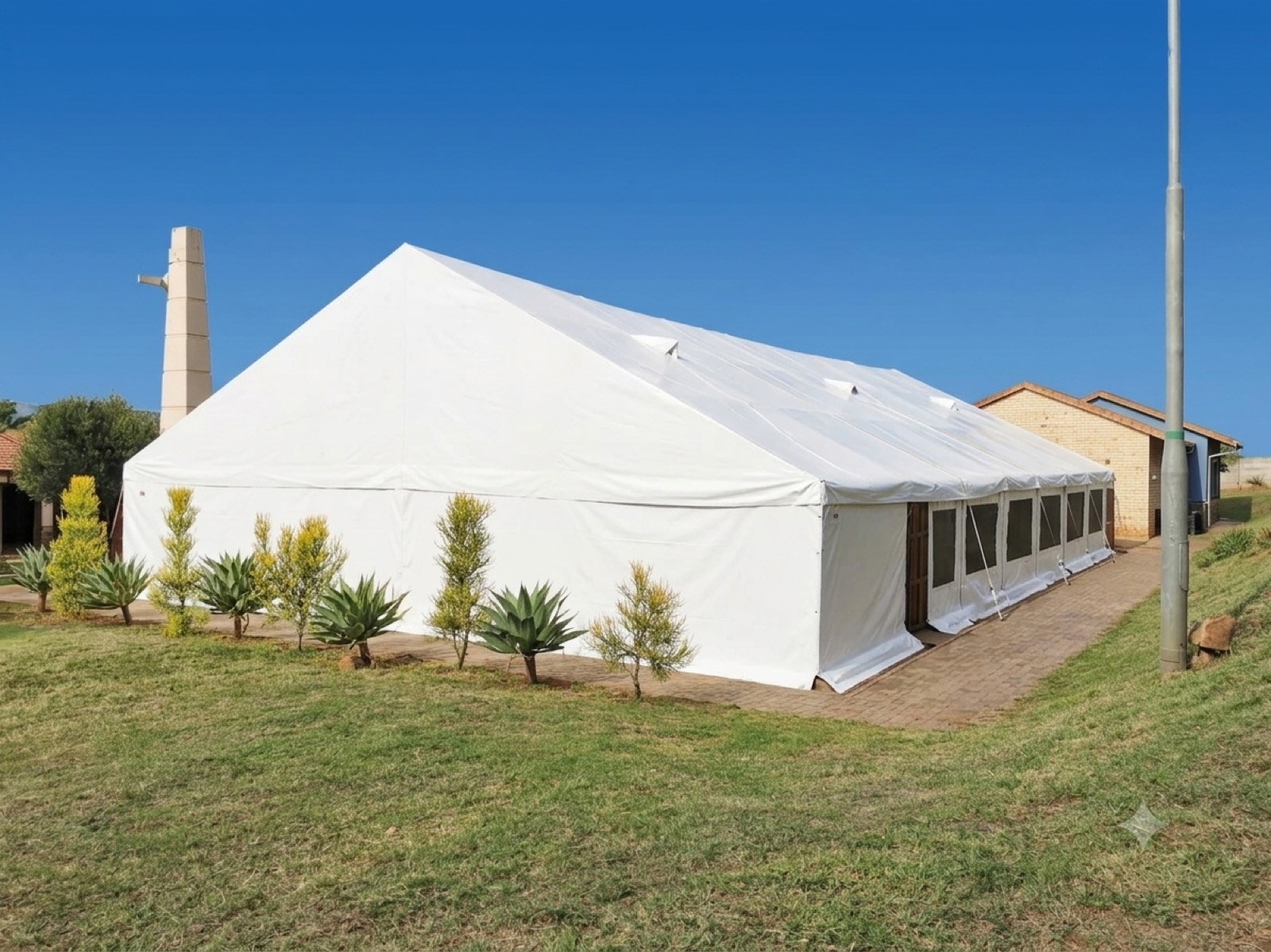
Buying a marquee tent is a significant purchase, and like most significant purchases, the quality differences between products are rarely obvious on first look. A well-photographed tent on a supplier's website can look identical to a genuinely well-built tent — until it faces its first Highveld summer, its first serious wind event, or its fiftieth erection and pack-down. By that point, you have already committed your money.
This checklist is built from twenty-five years of manufacturing marquee tents in South Africa. Use it as a guide when evaluating any marquee, whether you are buying from us or from any other supplier. A reputable manufacturer should be able to provide honest answers to every point below.
1. The fabric — the most important single component
The quality of the PVC fabric used to make a marquee tent determines more about its performance and lifespan than any other factor. Ask the following:
- Where is the PVC manufactured? South African-manufactured PVC is compounded and tested for local UV and climate conditions. Imported PVC from regions with lower UV intensity may not perform equivalently over time in the South African sun.
- What is the coating weight (gsm — grams per square metre)? A heavier coating means better waterproofing, better UV resistance and better abrasion resistance. Ask for the specification, not just a generic "heavy-duty" claim.
- Does it contain UV stabilisers? This is non-negotiable for any outdoor application in South Africa. Without UV stabilisers, the PVC will bleach, stiffen and eventually crack within one to three seasons of regular use. Quality PVC will hold its colour and flexibility for many years.
- What is the base cloth weave? A Panama or Oxford weave provides dimensional stability — the fabric holds its shape under tension without stretching out of form. Loosely woven or thin base cloths sag, distort and tear at stress points.
- Is the coating on both sides of the base cloth? Single-side coating is a cost-cutting measure that reduces performance. Both sides should carry a consistent, bonded PVC coating.
2. Seam and join construction
A tent's fabric panels must be joined, and the quality of those joins is a direct indicator of the overall build standard.
- Are the main seams welded or stitched? Welded seams — heat-welded or RF (radio frequency) welded — produce a truly waterproof bond between panels. Stitched seams, however well executed, leave needle holes through which water can eventually track. For a marquee roof, welded seams are the correct standard.
- Are stitched sections double-stitched? Where stitching is used for edges, hems and fittings, it should be double-stitched and, ideally, sealed with a PVC tape or sealant strip on the inside face.
- Do the seams lie flat under tension? Poorly executed seams pucker, buckle or create stress concentrations. Inspect a seam sample before purchasing and apply manual tension to it — a quality seam does not distort.
- Are ridge and hip seams reinforced? These high-stress areas on the roof carry the greatest tension loads and deserve additional reinforcement tape or webbing on the inside face.
3. Frame and hardware
The structural frame carries the load of the fabric and must withstand wind, rain and the stress of repeated erection. Check the following:
- Pole material and wall thickness: aluminium poles are lighter than steel; steel poles are typically stronger for equivalent wall thickness. In either case, ask for the wall thickness specification. Thin-walled poles bend or buckle at lower wind loads.
- Fittings and connectors: the fittings that join poles, carry ridge loads and connect guy ropes should be rated for the span of the tent. Die-cast zinc or aluminium fittings are standard; avoid thin pressed steel, which fails at the weld points under load.
- Guy ropes and pegs: for peg and pole marquees, the guy rope system is a critical safety element. Guy ropes should be of adequate diameter (typically 8–10 mm for larger tents), properly terminated at both ends, and the pegs should be of a length and gauge appropriate for the ground conditions at your venue.
- Frame powder coating or galvanising: untreated steel frames will rust, weakening the structure and staining the fabric. All steel components should be hot-dip galvanised or powder-coated.
4. Edge finishing and eyelets
The edges of the tent fabric are subject to the highest tension loads and the most repeated handling stress. Poor edge finishing is one of the most common failure modes in budget marquees.
- Hem construction: all edges should be folded and welded or stitched with a robust hem that distributes tension along the full perimeter. A narrow hem tears out. A wide, reinforced hem holds.
- Reinforcing webbing: quality marquees carry a woven webbing tape along the perimeter and at key stress points (ridge ends, corner pockets, mid-point rope attachment points). This webbing takes the primary load, protecting the PVC fabric from direct tension damage.
- Eyelet quality: eyelets should be brass or heavy-duty aluminium, set into reinforced patches. Thin steel eyelets rust and enlarge under repeated use. The patch around each eyelet should be reinforced with additional layers of PVC or fabric for pull-out resistance.
- Eyelet spacing: eyelets that are too far apart create high-load concentration points between them. Standard spacing is 400–500 mm on rope lines; tighter spacing is preferable on longer perimeters.
5. Windows, doors and sidewalls
The quality of windows and sidewalls affects both the usability and the weather performance of the tent.
- Window clarity and thickness: clear PVC windows should be scratch-resistant, reasonably thick, and properly hemmed into the sidewall panel so they sit flat. Thin or poorly fitted windows distort light, trap condensation and tear at the edges.
- Sidewall attachment: sidewalls should attach to the main structure cleanly and seal against the ground and roof connection points. Gaps at the base or roof edge allow wind-driven rain to enter. Look for a flap or batten system at the base.
- Door design: a properly designed entrance includes a door panel that attaches securely, can be rolled up and tied back, and has a weather-seal arrangement at both sides and the top. A simple slit or unsecured panel is not adequate for commercial or frequent use.
6. Warranty, aftercare and the manufacturer behind the product
The last item on this checklist is arguably as important as all the rest: who stands behind the tent, and for how long? A quality marquee tent manufacturer will offer a meaningful warranty against manufacturing defects, maintain the ability to supply replacement panels if a section is damaged, and provide a repair service for accidental damage. An importer who is reselling stock from overseas has none of these capabilities once the initial sale is made.
Ask any supplier directly:
- What is the warranty period and what does it cover?
- Can you supply a replacement panel if mine is damaged in ten years' time?
- Do you offer a repair service for accidental damage or wear?
- Can I visit your factory to see tents being made?
At Midrand Tarp & Tent, we manufacture every marquee at our Midrand, Gauteng factory. We have been doing this since 1999, we carry the expertise and materials to repair or replace panels across our full product range, and we are happy to show any customer around the factory before they buy. Buying from a manufacturer rather than a reseller means that the people who made your tent are the people who will look after it — and that relationship is worth a great deal over the lifespan of a quality marquee.
Buy direct from the manufacturer
Ask us any question about quality, specification or warranty — we reply within 24 hours, and we are happy to show you the factory before you commit.