Marquee tent safety tips for a secure event
Anchoring, weather, crowd flow and fire safety — practical tips to keep your marquee event safe and worry-free.
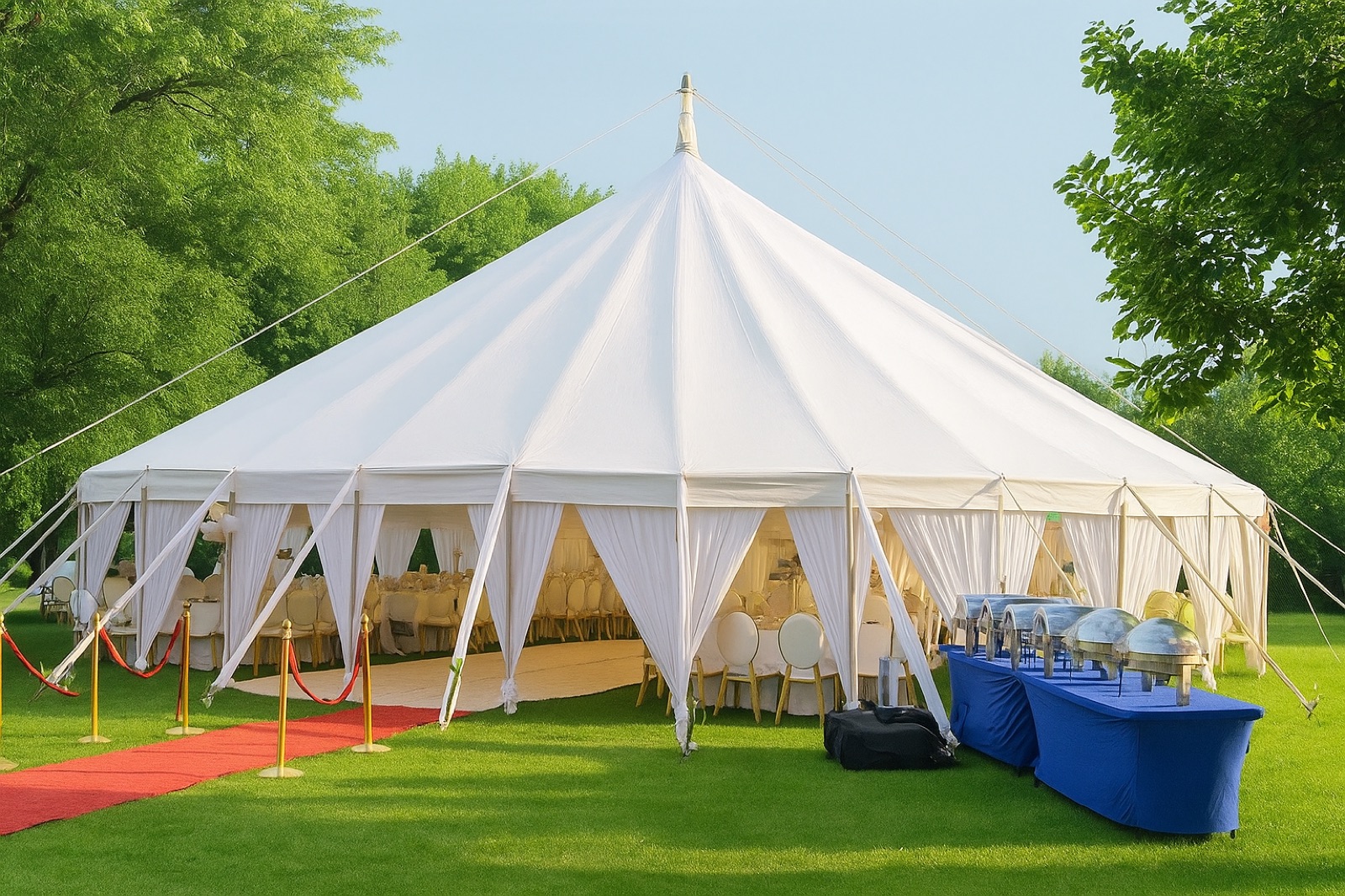
A marquee tent should be the highlight of your event, not a source of anxiety. With the right preparation — proper anchoring, weather awareness, clear access routes and a sensible fire plan — you can host hundreds of guests under canvas with complete confidence. This guide covers the practical safety principles that experienced marquee tent manufacturers and riggers apply to every installation.
1. Anchoring: the foundation of marquee safety
Anchoring is, without question, the most critical safety factor in any marquee tent installation. A tent that shifts or collapses in a sudden Highveld or Cape storm does not simply inconvenience guests — it is a serious structural hazard. South Africa's weather is notoriously variable: still mornings can give way to strong afternoon thunderstorms, especially in Gauteng between October and March.
For peg & pole marquees, the anchor system relies on steel pegs driven at the correct angle and depth for the ground surface — lawn, compacted soil and clay each behave differently under load. For hard or paved surfaces where pegging is not possible, water ballast blocks or concrete anchors are used to achieve equivalent holding strength. Framed marquees transfer load through their base frames, which must rest on stable ground and be secured at every corner and mid-span.
Key anchoring principles to check before any event opens:
- Every guy rope is taut and attached to a correctly specified anchor point for the ground type.
- Pegs are fully driven to the recommended depth — partially driven pegs provide a fraction of the holding strength.
- Water ballast blocks are filled to capacity and attached with rated hardware.
- No anchor lines cross pedestrian routes; where unavoidable, they are flagged and protected.
- The rig has been checked after any rain, as wet soil reduces peg holding strength.
When a specialist marquee tent manufacturer rigs the structure — rather than an unskilled labour team — the anchoring specification is matched to the size, weight and site conditions of each installation. That single factor is the most reliable safety measure you can take.
2. Weather monitoring and wind management
Marquee tents are designed to withstand moderate wind loading, but no structure is immune to extreme conditions. A responsible event plan treats weather as a live variable, not a fixed assumption made during the booking stage.
Before the event
Check the forecast the evening before and again on the morning of the event. The South African Weather Service and reliable weather apps provide localised warnings for thunderstorms and high-wind advisories. Appoint a named person on your team who is responsible for monitoring conditions throughout the day.
During the event
If wind picks up significantly, lower or close any open sidewall panels to reduce sail area. Secure loose items — table centrepieces, signage and décor can become projectiles. If conditions deteriorate to the point where guests feel uncomfortable, follow your evacuation plan calmly and early; it is always better to relocate guests to a solid structure with time to spare than to wait until the situation is urgent.
Side doors and entry flaps on quality PVC marquees can be opened partially to allow wind to pass through rather than build pressure against the canvas — your rigger will advise on the best approach for your specific tent configuration.
3. Fire safety inside a marquee tent
Fire safety is non-negotiable in any covered venue, and marquees are no exception. Quality commercial marquee PVC is manufactured with fire-retardant additives — this slows ignition and spread, but it does not make the material fireproof. Treat every marquee as you would any event venue.
- Cooking areas: Position gas burners, braais and catering equipment outside or in a clearly separated section with at least 3 m clearance from canvas walls. Use only approved gas connections and check fittings before the event.
- Heaters: Free-standing gas patio heaters must be kept away from canvas and secured against tipping. Electric radiant heaters are generally preferable inside an enclosed marquee.
- Lighting: LED par cans and fairy lights generate minimal heat; traditional halogen or tungsten flood lights must not touch or be positioned close to PVC or fabric liners.
- Fire extinguishers: At least two appropriately rated extinguishers should be accessible inside the marquee, clearly marked and not blocked by furniture or décor.
- Exits: All exits must remain clear and identifiable throughout the event — never allow catering tables, charging stations or décor to obstruct an exit path.
- No open flames: Candles and naked-flame table décor should be in enclosed holders and supervised at all times. Many venue insurance policies exclude open-flame incidents in temporary structures.
4. Crowd flow, capacity and structural load
One of the most common errors in marquee event planning is sizing the tent for the guest count without accounting for the functional layout. A marquee that seats 200 for a sit-down dinner does not comfortably accommodate 200 people moving around a cocktail-style event. Overcrowding creates both a crowd-safety risk and unnecessary structural pressure at access points.
Practical crowd-flow principles:
- Allow a minimum of 1.8 m clearance for main pedestrian aisles, and wider for wheelchair access.
- Position entry and exit doors on opposite sides of the marquee where possible to prevent bottlenecks.
- Identify emergency exits and mark them clearly; brief any catering or event staff before guests arrive.
- Do not attach heavy suspended loads (chandeliers, sound systems, lighting rigs) to tent poles unless the structure has been specifically rated and rigged for that load by a qualified rigger.
- Flooring adds load — raised wooden flooring on soft ground must be checked for level and stability before the event opens.
5. Electrical safety under canvas
Power management in a marquee requires the same discipline as any other temporary structure. Use only a qualified electrician to run supply cables, connect distribution boards and install any lighting or sound systems. Key points:
- All cables routed across foot-traffic areas must be covered with cable ramps or run overhead to prevent trip hazards.
- Distribution boards should be positioned outside or in a designated area away from direct access, with appropriate earth leakage protection.
- Generator exhausts must never vent inside or adjacent to a closed marquee — carbon monoxide build-up is a serious risk in an enclosed tent environment.
- All connections should be weatherproofed if there is any chance of rain ingress.
6. The role of quality manufacturing in marquee safety
Every safety measure above is made easier — or harder — by the quality of the tent itself. A marquee manufactured from quality PVC with reinforced stress points, double-stitched seams and correctly rated fittings will hold its shape and anchoring under conditions that compromise a lower-grade structure. This is particularly relevant in Sub-Saharan Africa, where UV exposure, temperature extremes and sudden high-wind events test canvas and hardware far harder than the European climates for which many imported tents are rated.
As a marquee tent manufacturer based in Midrand, Gauteng, we build to handle South African conditions — not European averages. Our PVC canvas, poles, fittings and stitching are specified to work together as a system, which means the structure performs as intended when conditions become demanding.
Frequently asked questions
How do I know if my marquee is properly anchored?
The anchor points should be taut with no slack in guy ropes, pegs should be fully driven to the recommended depth, and there should be no movement in the frame or canvas when you push against a sidewall with reasonable force. For large events, a professional rigging check before guests arrive is strongly advisable.
Can I use my marquee in strong wind?
Quality marquee tents are rated to handle moderate wind when correctly anchored and configured. In high-wind conditions (typically above 40–50 km/h), sidewall panels should be closed or partially open to reduce sail effect, and you should follow your event's weather contingency plan. If in doubt, prioritise guest safety and follow the advice of your tent manufacturer or rigger.
Do marquee tents need fire-retardant canvas?
For commercial and public events, fire-retardant canvas is strongly recommended and may be required by venue operators or local authorities. Reputable marquee manufacturers supply PVC canvas treated with fire-retardant additives. Always confirm this specification when commissioning a marquee for events with a public audience.
Who is responsible for marquee safety at an event?
Responsibility is shared: the marquee supplier is responsible for correct installation and structural integrity; the event organiser is responsible for site management, electrical supply, catering safety, crowd management and compliance with any municipal by-laws or venue requirements. For large public events in South Africa, a designated event safety officer is best practice.
Plan a safe, well-specified event
Our team can advise on the right marquee tent size, anchor method and rigging approach for your site. We've been doing this since 1999 — get a quote within 24 hours.