Why quality components matter for your marquee tent
The tent is only as good as its poles, fittings and finishing. Here's why the components you can't see make all the difference.
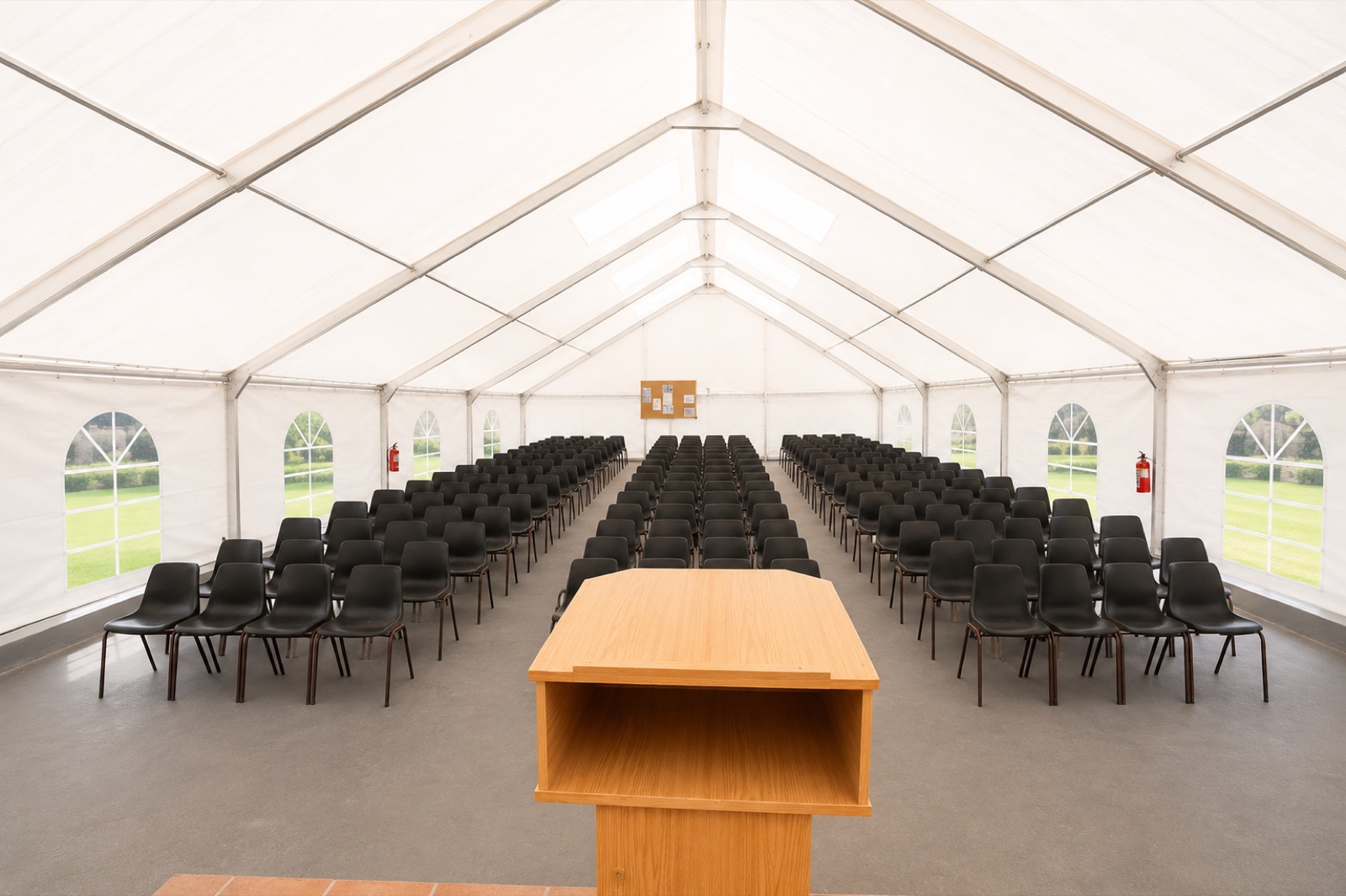
When buyers compare marquee tent prices, the instinct is to compare canvas size and visible finish. The canvas is the part you see in the photos — the part the salesperson talks about. But the components you cannot see when the tent is standing — the poles, fittings, seam construction, ropes, buckles and hardware — are what determine how long the tent performs and how it behaves when conditions become demanding.
Understanding where quality actually lives in a marquee tent helps you make an informed purchasing decision — and helps you understand why tents at seemingly similar sizes carry very different price points.
The structural frame: poles and fittings
Marquee tent poles bear the structural load of the canvas — the weight of the PVC itself, plus the additional force of wind pressure against the sidewalls and roof. The poles must be stiff enough to resist bending under those loads, and the fittings that connect them must hold securely across thousands of assembly and disassembly cycles.
Steel vs aluminium poles
Commercial marquee tent poles are typically manufactured from either galvanised steel or aluminium, each with different performance characteristics:
- Galvanised steel poles offer high stiffness and load-bearing capacity at competitive cost. They are the standard for commercial peg & pole marquees. The galvanising process protects against corrosion, but scratched or chipped galvanising on a low-quality pole will rust at the contact points, compromising fitting integrity over time.
- Aluminium poles are lighter and inherently corrosion-resistant, making them better suited to coastal environments and applications where the structure is frequently transported and assembled. They are typically used in framed marquees and high-specification commercial tents. Weight saving makes a meaningful difference when a large structure is assembled and dismantled repeatedly.
Fittings and hardware
Fittings are the joints, crowns, connectors and ridge hardware that hold the pole system together. On a quality tent, these are manufactured from pressed or cast metal with tight tolerances, surface-treated against corrosion and designed for repeatable assembly without distortion. On a low-cost tent, fittings are often pressed from thin steel without adequate treatment — they flex slightly on every assembly, work-hardening and eventually cracking at stress points. The failure typically happens not when the tent is new, but after 20 or 30 assemblies, precisely when the owner has stopped treating the tent as a new purchase and started relying on it.
When evaluating marquee tent quality, ask to examine the fittings closely. Look for even surface finish, no visible casting porosity or thin sections at stress points, and a snug — not loose — fit between pole and fitting.
PVC canvas: weight, weave and treatment
The canvas is the most visible component of any marquee tent and the one where the quality spectrum is widest. Commercial PVC marquee canvas is a laminated product: a woven base fabric — typically polyester — coated on both sides with PVC compound. It is the specification of this laminate structure that determines performance.
Fabric weight
Canvas weight is measured in grams per square metre (gsm). Heavier canvas is generally more durable, more tear-resistant and better at excluding light. Commercial marquee canvas typically ranges from around 450 gsm for lighter applications to 650 gsm and above for heavy-duty or long-service structures. Very low-weight canvas (below 380 gsm) is suitable for short-term or lightweight applications but will not hold up to repeated outdoor use in South African summer conditions — the UV exposure and heat alone are significantly harsher than the European climates for which much imported canvas is rated.
Weave structure
The base fabric weave — the pattern in which the polyester threads interlace — affects tear strength, stretch resistance and how well the PVC coating bonds to the substrate. A tight Panama (basket) weave is a standard for quality commercial marquee canvas, providing good balance between strength, flexibility and coating adhesion. Loosely woven base fabrics allow the PVC coating to shift under stress, eventually delaminating at the points of highest movement.
UV stabilisation and fire retardancy
Quality PVC canvas for outdoor use incorporates UV stabilisers in the coating compound to slow the degradation of both the PVC surface and the underlying polyester threads. Without UV stabilisation, the PVC becomes brittle and chalk-white under prolonged sun exposure — typically within 2–3 years in South African conditions. Fire-retardant additives are also incorporated in canvas intended for events with public audiences, slowing ignition and the spread of flame. Always confirm that canvas purchased for commercial event use carries the appropriate treatment.
Seam construction and stitching
Seams are the weakest points in any canvas structure. The quality of the seam — how the panels are joined, how the seam is finished and what thread is used — is a direct indicator of overall manufacturing quality.
- Double-stitched seams use two parallel rows of stitching, significantly increasing resistance to seam pull-out under tension compared to a single stitch line.
- Heat-welded or taped seams are used on some premium canvas products to create a fully waterproof join — stitching alone creates needle holes through which water can track in heavy rain.
- Thread quality: UV-degraded or untreated thread is frequently the first component to fail in a budget tent. The canvas may still be intact while the stitching disintegrates. Quality manufacturers specify UV-stabilised thread throughout.
- Stress points: Corners, tie-down loops, eyelets and rope anchors experience significantly higher load than the general canvas. These should be double-reinforced — either stitched through multiple layers of canvas or fitted with metal ring reinforcements rather than simple punched eyelets.
Ropes, straps and anchor points
A marquee tent's anchoring system is only as strong as its weakest point — and that point is often the ropes, straps or buckles through which the tension is transferred from the canvas to the pegs or ballast. Quality commercial tent ropes are woven polypropylene or polyester with rated breaking strength appropriate to the load; they are UV-stabilised and resist kinking and abrasion. Low-cost ropes become stiff and brittle with UV exposure, making them difficult to tension correctly and prone to snap at peak load.
Buckles, tensioners and clamps should be pressed or cast metal — not lightweight plastic clips that can fatigue and release without warning. On any tent used commercially, inspect all anchor hardware before each event.
Windows and doors: the practical details
Clear PVC windows and door apertures seem like minor details until they fail. Quality windows are made from optically clear PVC of sufficient gauge to resist wrinkling and yellowing with age. Windows should be bonded and stitched to the main canvas panels with a neat, waterproof seam — poorly attached windows are a common failure point in budget marquees, both from the aesthetic perspective and structurally where the window joins the panel. Zip or rollup closures for windows and doors should be heavy-duty, easy to operate under tension and not the first component to fail.
What to look for when evaluating a marquee tent
- ✓ Canvas weight and weave: minimum 500 gsm with tight Panama weave for commercial use
- ✓ UV stabilisation and fire-retardant treatment confirmed
- ✓ Double-stitched seams; reinforced stress points and eyelets
- ✓ UV-stabilised thread throughout, not standard polyester
- ✓ Pole material appropriate for use case (steel or aluminium)
- ✓ Fittings: pressed or cast metal, snug tolerances, no surface porosity
- ✓ Ropes: UV-stabilised polypropylene or polyester with rated breaking strength
- ✓ Buckles and hardware: metal, not plastic
- ✓ Windows: optically clear, properly bonded and stitched, not yellowing
- ✓ Manufacturer based in South Africa and accountable for after-sales support
Get a properly built marquee
We manufacture marquee tents in Midrand from quality PVC canvas and properly rated hardware. Tell us what you need and we'll send you a full specification and quote within 24 hours.